AndreW Dimirjian
Work StatementBio+CVCurrent EventsContact

Installation

Single Channel

Performance


Scenes From Last Week (2011)

Andrew Demirjian

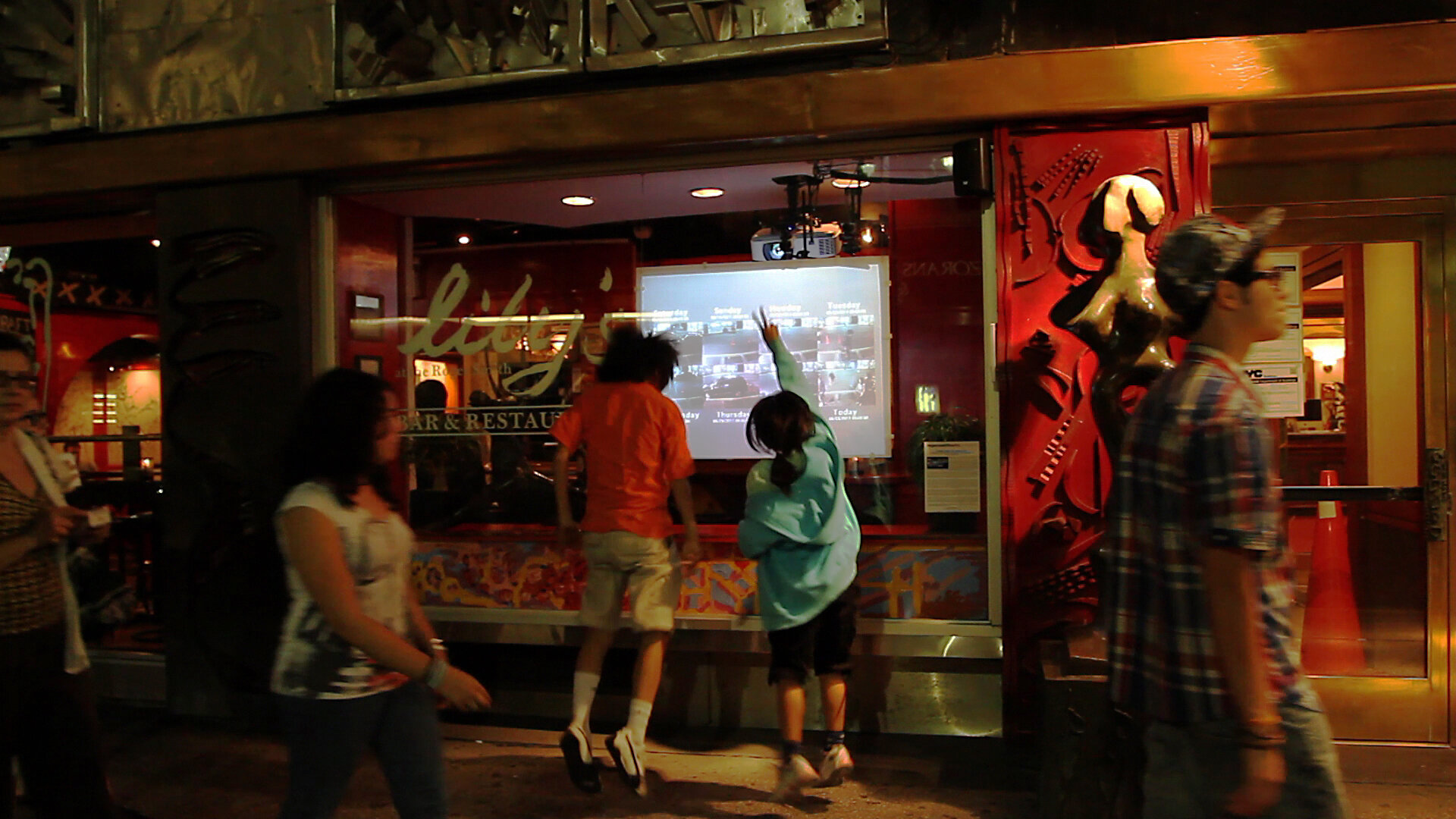
In a city constantly moving forward and erasing its relationship with the past, Scenes from Last Week seeks to re-insert the past into the present. The work is a public art installation that uses video surveillance cameras and monitors in two storefronts directly across the street from each other. In addition to showing the current street view the monitors display the view from seven previous days synchronized to the present moment, giving the passerby the chance to see the immediate history of where they are standing. The work creates a digital hall of mirrors, a perceptual trip wire into the past, intended to reawaken our senses to randomness and ritual in our daily environment.

This work was created during an artist residency at Eyebeam Art and Technology Center in New York. The piece was presented in midtown by The Roger Smith Hotel and Beekman Liquors in June of 2011 and at 218 and 225 14th St. in collaboration with Art in Odd Places in July/August 2011 (the participating venues were Rags-a-GoGo and 14th Street Framing Gallery). The work explores the tension between fear of surveillance and our love of being on camera.


The Week in Review (2010)

Andrew Demirjian

The Week in Review maps the stock price fluctuations of the three largest companies in the music industry to musical notes and visuals. The piece highlights the role of the global marketplace in music by reversing the traditional industry relationship that turns speculations on music into money; instead it turns speculations on money into music.

The Week in Review is an interactive audiovisual projection that participants can play through a turntable and LED clock interface. When the piece is not being played there is a program mode that creates patterns from the week of data. The documentation is from Eyebeam Project Space in June 2011.


Sony PVM-14N5U VS. Sharp 19C-M100R (2010)

Andrew Demirjian

Sony PVM-14N5U VS. Sharp 19C-M100R uses a double surveillance system of video cameras watching their own image and a multi-camera surveillance video to observe and listen to a screen looking at itself. Video feedback from these two television monitors is multiplied, projected and reflected across the installation space creating a chaotic, fluctuating system. Direct contact to this environment is denied the visitor to the gallery but instead can only be explored by a PS3 game controller choosing from multiple views that allow the visitor to be their own “editor” of the work. Each participant/editor chooses different cameras, pans, zooms and mobile camera work.


Color Field (2009)

Multi-channel video installation

Dozens of unwanted television sets from Craig's List were put into a piling lot in Asbury Park to create a video installation for the TriCity Arts Festival. The videos are three short pieces that reflect on the cathode ray tube as the country switches from analog to digital reception.

Technical information: Part 1 uses the brightness fluctuations of video feedback to control a noise signal that simulates an ocean wave. The video feedback fills a 3D model that is scaling in response to the brightness fluctuations as well. The second part is a NTSC color bar that has certain colors being knocked out then different sections of the screen are being randomly sampled while an audio oscillator is reading the center scan line. The third part manipulates a television set being turned on and off with the center scanline being read to create the soundtrack.


Nitrogen Cycles (2009)

Andrew Demirjian & Zachary Seldess

Nitrogen Cycles is an 8-channel sound art installation that sonically maps the daily activity of live fish into the gallery space. A rectangular fish tank stands in the center of the gallery and each fish is assigned a unique tone that spatially travels through the rectangular gallery corresponding to that fish’s activity. The music generated is a reflection of the dynamic shifts in the location, speed and the relationship between the fish in their daily lives. Through motion and color tracking a sonic transposition is created that immerses the listener into an aural experience of the movements inside the fish tank. This twists the visitor’s traditional sensory experience by putting their ears inside the tank and the eyes outside of it.

Four speakers are low to the ground and an additional four are over six feet high in the air, so we hear the fish sound travel and pan with height fluctuations as well as width. The pitch scales from low to high on the y-axis, and the x-axis controls a tremolo effect that is fastest at the center of the tank and slower at the edges. When a fish moves quickly the sound is processed with a filtering effect that emphasizes their sharp movement.


Red Shirt, Black Shirt, Staircase (2008)

Two-channel video installation

The piece re-examines the mundane location of a stairwell, a space whose primary function is to transition people to another space, and instead makes it the primary focus of attention. The sonic environment of this location is explored by repeated journeys up and down the stairs and the discovery of the individual squeaks and sonic characteristics of each step. This audiovisual data is then fed into an algorithm that generates random excerpts, allowing the work to organically and endlessly evolve in unexpected patterns.


Maybe, Almost, Always (2008)

Twenty-one HD televisions, computers & motion tracking at Canco Lofts, Jersey City, NJ

Maybe, Almost, Always is an experimental documentary that maps personal landscapes - an interactive dialogue in video between artists, participants, and viewers, about Jersey City, NJ. Residents of Jersey City were asked sensory questions about their neighborhood, and these responses were used as a catalyst for the images that appear on the screens. Together, words and images fuse to describe a physical and psychological landscape.

Highway 63 Revisted (2007)

Excerpt

Bucket seats and dual screen mobile DVD system, mixed media installation at Emerge 8 Exhibition, Aljira, Newark, NJ

Highway 63 Revisited is a video sculpture that consists of a pair of video screens, strapped to the backs of car seats, showing a man and a woman having a conversation in a car. Their talk is punctuated with interior monologues, the man and the woman reflecting on each other and on the conversation. The piece explores the relationships and tensions between the sexes.

Rustle of Language (2006)

Four-channel video installation, Newark Museum, NJ

Rustle of Language explores how the brain makes meaning in a world of media saturation. The work non-hierarchically excerpts and mixes Stuart Hall’s essay “Critical Dialogues in Cultural Studies”, the celebrity profile magazine In Touch, the meditation guide-book Wherever You Go There You Are, and Dr. Seuss’ Oh, The Places You Will Go, to create a new audio visual narrative.

Figure of Speech (2006)

Four-channel video installation, Newark Museum, NJ

A series of self-portraits in audio and image that use the mundane non-verbal sounds of the mouth and throat (yawns, throat clearings, coughs, syllables, vowels, etc…) to communicate raw messages that conscious language dilutes or conceals.  The sounds are then played on different monitors, and orchestrated like musical instruments to sketch fleeting psychological states as internal aural landscapes.

M/M (2005)

Five-channel video installation, City Without Walls, Newark, NJ 

M/M deconstructs the film Bad Boys II into five code categories based on Roland Barthes’ narrative analysis in S/Z. Video of each code category: Actions, Enigmas, Signifiers, Symbols, and References, plays on its own monitor.

Gdansk, Talk Back (2004) (excerpt)

Collaborative project with Dahlia Elsayed

Two-channel video installation and book

Residents of Gdansk, Poland were filmed while asked targeted, sensory questions about describing their place and its meaning (their body, this room, this street, city, country.) Participant responses were then joined with a variety of my own images, motion graphics and audio, relevant to the participant’s words and gestures. The result is a documentary poem mapping personal landscapes - a collaborative dialogue in video between artist, participants, and viewer.